
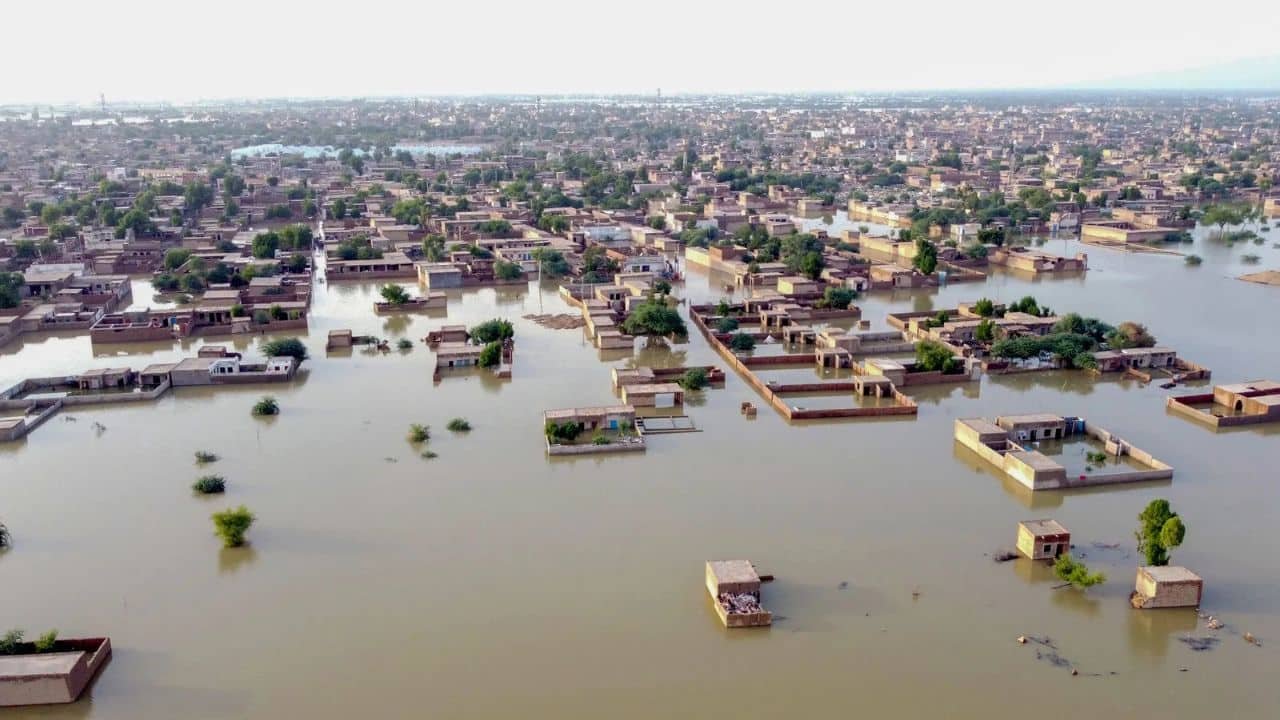
Climate change could cut Pakistan’s gross domestic product (GDP) by 21.1 percent by 2070 under a high-end emissions scenario, says the Asian Development Bank (ADB).
The Bank in its latest report “Asia-Pacific Climate Report 2024, Catalyzing Finance and Policy Solutions”, noted that climate change could lead to a 17 percent GDP drop across Asia and the Pacific region by 2070 under a high-end emissions scenario, which could rise to 41 percent of GDP by the end of the century.
The projected climate effects of sea level rise and labor productivity losses will be the most damaging – with lower-income economies and the region’s poorest set to be the hardest hit.
The report noted that among the assessed countries and subregions, these losses are concentrated in Bangladesh (–30.5 percent), Viet Nam (–30.2 percent), Indonesia (–26.8 percent), India (–24.7 percent), “the rest of Southeast Asia” (–23.4 percent), higher-income Southeast Asia (–22.0 percent), Pakistan (–21.1 percent), the Pacific (–18.6 percent), and the Philippines (–18.1 percent).
Losses increase at a higher rate over time, as the difference between 2050 and 2070 losses is greater than between 2030 and 2050. These losses are far above prior model-based losses and are consistent with the upper bound of econometric estimates. They also confirm that climate policy responses, including adaptation and mitigation, will be essential to the future welfare of the Asia and Pacific region.
For many countries, effects on labor productivity from heat waves are large and rank second or even dominate losses. The GDP loss in 2070 from reduced labor productivity is found to be 4.9 percent for the region. The most impacted locations are tropical and subtropical. These include “the rest of Southeast Asia” (–11.9 percent), India (–11.6 percent), Pakistan (–10.4 percent), and Viet Nam (–8.5 percent).
Losses are substantial in the natural resource sector, encompassing agriculture, forestry, and fisheries. The economic loss from shocks to these climate-dependent sectors is 2.1 percent of GDP across the region by 2070. The combined losses from these sectors are largest in Pakistan (–12.0 percent), “the rest of South Asia” (–6.0 percent), the Philippines (–4.7 percent), higher income Southeast Asia (–4.5 percent), Indonesia (–4.5 percent), “the rest of Southeast Asia” (–4.3 percent), and Viet Nam (-4.1 percent).
With the largest economic impacts of climate change occurring in those areas of Asia and the Pacific with lower relative incomes—such as Bangladesh, India, Indonesia, Pakistan, the rest of Southeast Asia, Viet Nam, and the Pacific—via channels such as increased coastal inundation, lower labor productivity, and lower natural resource productivity, poor communities are likely to be most affected. Poor people are most likely to live in areas exposed to flooding and storm surges, to depend on natural resource sectors for livelihoods, and/or to work in sectors exposed to increasing heat. They also have the lowest capacity to adapt and cope with these shocks.
About the Author
Written by the expert legal team at Javid Law Associates. Our team specializes in corporate law, tax compliance, and business registration services across Pakistan.
Verified Professional
25+ Years Experience