
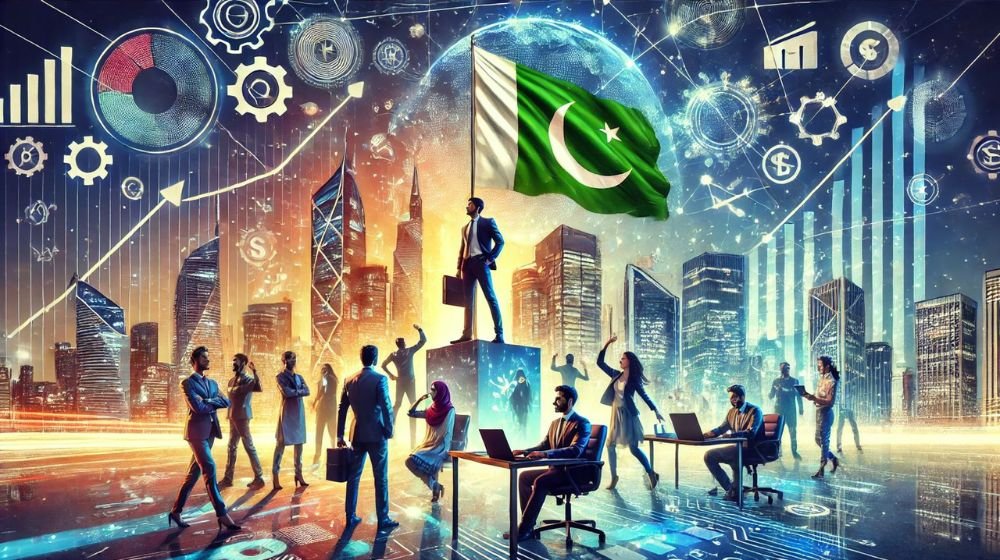
Pakistan’s burgeoning population of over 241 million and its rich demographic dividend as the world’s fifth-largest youth population present immense potential and considerable challenges to economic growth and development. Effectively harnessing the potential of Pakistan’s youth entrepreneurs and SMEs is no longer a question of choice but an imperative in the path to economic prosperity.
According to comparative data, the US, with a population of 333 million, has 33.5 million SMEs. Indonesia, with 276 million people, has 62 million SMEs, while India, with a population of 1.4 billion, boasts 75 million SMEs.
Data from these similar developing economies demonstrate that SMEs’ digitization and financial inclusion contribute 0.4-0.6% to the GDP annually. If Pakistan’s current 5.2 million SMEs grow to 10 million within the next 5-7 years, it could significantly boost the economy, potentially doubling employment within the SME sector and substantially increasing GDP through job creation, innovation, enhanced productivity, and overall economic stability.
Drawing insights from advanced economies, it is imperative to comprehend the broader context through practical instances of small and medium-sized enterprises (SMEs) that have transitioned from cash-based to digital financial systems. Developed markets are shaping the digitalization trajectory, disrupting traditional business paradigms.
Square in the United States is a compelling case study of digital financial solutions tailored for micro, small, and medium businesses. Leveraging platforms such as Square, SMEs have successfully digitized their operations, improved financial transparency, and streamlined tax compliance. This transition serves to formalize business operations and augments their scalability.
Empirical analyses of businesses such as The Epicurean Trader, an upscale grocery establishment situated in San Francisco (USA), reveal its origins as a singular entity, necessitating a robust system to facilitate rapid expansion. Square’s digital financial tools provided the means to effectively manage inventory, monitor sales, and extract customer insights to enhance product offerings. Formalizing their business allowed them to unlock opportunities for expansion while meeting tax obligations, enabled them to secure improved credit terms, gain supplier trust, and qualify for government grants. Consequently, this facilitated expansion to four locations, accompanied by a notable 47% year-over-year revenue growth. Presently, the business manages an impressive 30,000 transactions per month, a volume that would have been unmanageable without the implementation of Square’s system.
In emerging markets like Brazil, Indonesia, and India, the growth of SMEs and young entrepreneurs has been facilitated by the collective support of banks, fintech solutions, and government initiatives. This collaborative ecosystem helps young entrepreneurs overcome challenges such as access to capital, financial literacy, and market entry barriers. For instance, Warung Pintar, a tech-based startup, empowers Indonesia’s traditional warung (small shops) to digitize their businesses. Many young entrepreneurs in Indonesia have entered the retail space using this platform, allowing them to modernize their operations and compete in the growing digital economy.
Fintech platform OVO and digital wallets like GoPay enable these warungs to accept digital payments, manage finances, and build credit histories. These tools have been instrumental in driving financial literacy and formalizing small, cash-based businesses. Indonesia is focusing heavily on integrating 30 million MSMEs into the digital economy by 2025.
Government initiatives like Indonesia’s Digital Economy 2025 Vision have prioritized financial inclusion and innovation, fostering a fertile environment for young entrepreneurs to thrive. Integrating digital banking platforms, microloan schemes, and financial literacy programs, enables SMEs to formalize their businesses, improve tax compliance, and scale efficiently.
In this context, Pakistan’s financial institutions play a crucial role in empowering youth and nurturing future entrepreneurs. The digital revolution in the country presents crucial opportunities for SMEs and financial institutions. With increasing internet access across Pakistan, digital banking platforms can provide unprecedented access to financial services, even in remote areas. Mobile banking apps, online loan applications, and digital financial education tools can democratize access to financial resources and knowledge.
Additionally, financial institutions can offer SMEs essential business planning support and networking opportunities – all crucial for long-term success. Banks can also serve as catalysts for innovation by supporting incubation centers and accelerator programs, thereby contributing to establishing a dynamic ecosystem that fosters startups and drives job creation. As critical stakeholders in the economic sphere, banks should push for policies with regulators and government that create an enabling environment including streamlined business registration processes and tax incentives for startups.
The introduction of Mashreq Digital Bank in Pakistan presents a significant opportunity to reshape the financial landscape for young entrepreneurs, freelancers, SMEs, and women-led businesses. Mashreq, a well-established player in the UAE’s banking sector with over 50 years of experience serving in 14 countries, is known for its digital-first banking solutions and ability to onboard and serve clients within and outside the UAE. This international experience positions Mashreq uniquely to introduce its innovative and proven digital banking models in Pakistan to drive financial inclusion, accelerate SME growth, and support the country’s export-oriented businesses. Its commitment to being a ‘Bank for All’ and championing financial inclusion, with a particular focus on empowering women, youth, and SMEs, represents our optimism and drive to spur growth in the market.
The road ahead is challenging but full of potential and Mashreq is committed to helping Pakistan’s SMEs and entrepreneurs write a new chapter in Pakistan’s economic story, where every young person rises and contributes to the nation’s progress.
These insights have been shared by Muhammad Hamayun Sajjad. He is the CEO of Mashreq Pakistan.
About the Author
Written by the expert legal team at Javid Law Associates. Our team specializes in corporate law, tax compliance, and business registration services across Pakistan.
Verified Professional
25+ Years Experience