
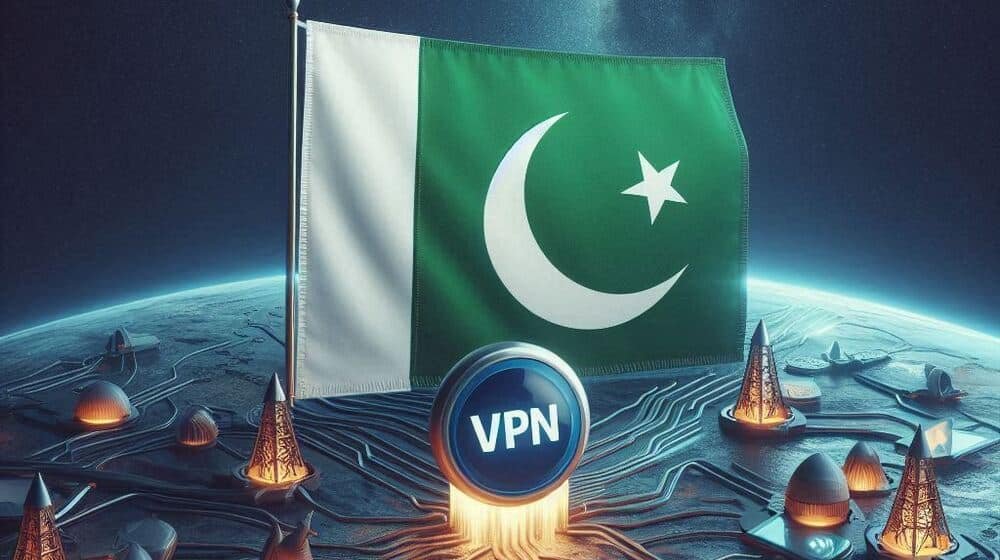
The potential short and medium-term economic impact of restrictions on Virtual Private Networks (VPN) are significant and the lack of clarity on internet policy is estimated at $420 million, with potential long-term damages surpassing $1 billion, resulting from a reported decline of 30 percent of order booking.
This was revealed by Sajjad Mustafa Syed, Chairman Pakistan Software Houses Association (P@SHA), accounting for over 90 percent of Pakistani IT exports, while briefing the Senate Committee on Information Technology and Telecommunication here on Thursday.
“While we respect and support national security objectives, we believe that the current approach of only limited the IP whitelisted registered IPs and lack of clear long-term policy on VPN and internet use, is counterproductive”, he added.
IT and ITeS exports stand at $3.2 billion as per State Bank of Pakistan’s data, growing at a Compound Annual Growth Rate (CAGR) of 22.6%–one of the fastest-growing export sectors in the economy; the largest employers of youth, empowering over 600,000 skilled labor force, and 2.37 million Freelancers according to PAFLA and ADB report. Around 3.0 million households today are dependent on IT and IT-related exports. With consistent policies and stable infrastructure, this figure has the potential to reach $15 billionby 2030.
Unstable internet connectivity, and uncertainty about the use of VPN, jeopardize the very foundation of the industry. Reliable internet is not just a convenience; it is the lifeline of IT and ITeS businesses, and the only means available to us to export our services. Past disruptions have already eroded investor and consumer confidence, resulting in economic losses, and diminishing of Pakistan’s global standing. According to freedomhouse.orq, Pakistan scores 27 out of 100 in Internet Freedom, well below all our global competitor countries like India which scores 50, Bangladesh, and Philippines (61).
As per FIDE reports, Pakistan incurs substantial economic losses due to internet disruptions, estimated at approximately Rs. 1.3 billion per day. Another estimate of 2023, accounts for a loss of $1 million per hour Internet outage.
The potential short- and medium-term economic impact of restrictions on VPN are significant and lack of clarity on internet policy, with estimated losses of $420 million. This conservative estimate includes $320 million in direct revenue loss from reduced IT export efficiency, $20 million in compliance costs for companies seeking alternatives, and $126 million from a 30% productivity decline among freelancers.
Conservatively, the short-term immediate losses to the IT sector from these announced restrictions and a lack of long-term policy are estimated at $420 million, with potential long-term damages surpassing $1 billion, resulting from a reported decline of 30% of order booking – a grim statistic.
He said stable internet infrastructure, including free access to VPNs, is indispensable for the industry. Stable and secure infrastructure is not a luxury, it is an essential tool for secure communication, data protection, and meeting global compliance standards like the General Data Protection Regulation (GDPR) and the California Consumer Privacy Act (CCPA).
National security is a global concern and all countries in the world have mechanisms where digital terrorism is contained. The only whitelisting path taken by us is the path that is taken by economies that do not provide software and services to North America, EU, UK and the Middle East. The current whitelisting-only VPN method is followed by Iran, Turkmenistan, North Korea, China & Russia. China and Russia are not IT export powerhouses compared to countries of similar economic sizes, and unlike Pakistan, they have a strong hardware industry to supplement their software growth. All other countries are far below our current IT exports. We need to follow the digital counter-terrorism methodology of our main competitor countries, like Vietnam, Philippines, Ireland, India, etc. so our industry enjoys the same infrastructure that our global competitors have, he added.
The current whitelisting-only approach has the following risks.
He further said that this is not just about restrictions on the internet, it is about preserving Pakistan’s digital future. It is about the livelihood of millions of households; it is about the future of millions of youth who are currently enrolled in computer science programs in our country. It is about future economic growth and the economic freedom of our great nation, he added.
About the Author
Written by the expert legal team at Javid Law Associates. Our team specializes in corporate law, tax compliance, and business registration services across Pakistan.
Verified Professional
25+ Years Experience